The Park-Is-Always-Open Assumption
Public park access depends on more than legal status. Learn how opening hours, gates, routes and everyday rules shape who can use a park and when.
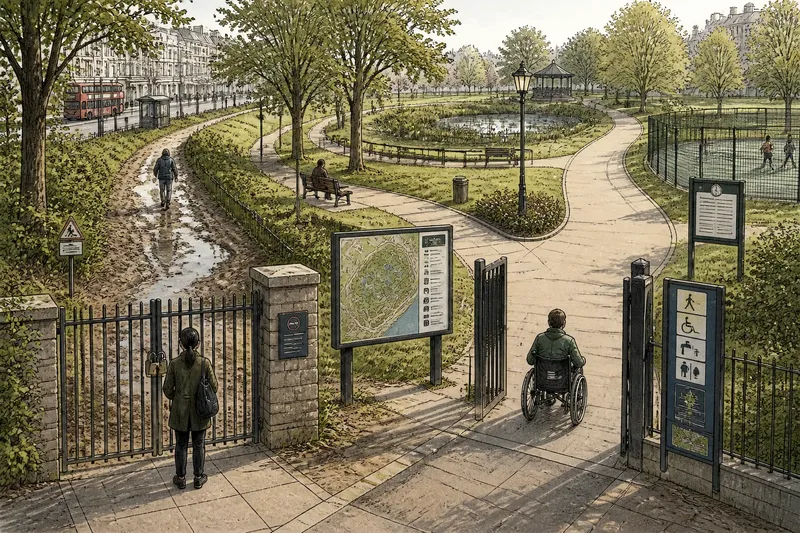
A public park is not equally usable at every hour, even when it remains public in law. Public park access depends on opening hours, entrances, paths, lighting, maintenance and the ordinary decisions that determine whether someone can actually get in and stay.
The distinction is easy to miss because “public” sounds like a simple permission. In practice, it describes a relationship between a place and its users, not an assurance that every route, activity or time of day will suit everyone. A locked gate is the most visible limit; a path that becomes impassable after rain is quieter, but no less relevant to a person trying to cross the park.
Public, not perpetual
Many parks have stated opening and closing times. Others are technically open but have gates, staffed facilities or particular areas that operate on narrower schedules. A park may also close temporarily for maintenance, events, severe weather or damage. Those conditions do not automatically make it private. They do affect when public access is available.
It helps to separate three questions:
- Status: Is the land designated or managed as a public park, with access rights or policies that apply to the public?
- Availability: Which entrances, paths and facilities are open at the time someone wants to visit?
- Usability: Can that person reach and use the available space in a practical, comfortable way?
The answers can differ. A park can be publicly accessible while its toilets are closed. A route through it can be open while a sports court is booked. A gate can be unlocked, yet a flooded low path may leave only a steep or distant alternative. Public status is the starting point for understanding access, not its final description.
Entrances tell a story
Count the entrances on a map, then consider where they lead from. A park with several gates on one busy road may have fewer useful points of entry than its map suggests. Someone arriving from a bus stop, a nearby estate or a school may face a long detour if the closest entrance is kept locked outside staffed hours.
Gate design matters too. A narrow turnstile may allow a pedestrian through but exclude a wheelchair, a cargo bike or a parent pushing a double buggy. A wide gate may be present but routinely secured, with no clear way to request access. The relevant question is not merely whether an entrance exists, but whether it is open, legible and usable from the routes people actually take.
Imagine a resident walking home from a late shift and finding the park’s nearest gate shut, although the far-side entrance remains open. The public status has not changed; the walk has. A council reviewing the arrangement could compare the gate schedule with nearby footpaths and public transport, then consider whether an alternative entrance can remain available without compromising the park’s management needs.
This is a modest audit, not a case for leaving every gate open indefinitely. It asks who bears the inconvenience of the chosen boundary, and whether the same people repeatedly do.
Hours shape ordinary use
Opening hours affect more than recreation. Parks can provide a walking route, a place to sit between errands, a quiet route to school or a nearby patch of shade. If a park closes before some residents finish work, those uses disappear for them, even if the park is busy at other times.
Longer hours are not automatically better in every setting. Managers may need time for cleaning, repairs, wildlife protection or event preparation. The useful policy question is whether the schedule reflects those needs in a clear and proportionate way, and whether different parts of the park could be managed differently.
For instance, a large park might have a lit perimeter path that remains available later than a wooded interior, or a route to a transport stop that stays open while a play area closes. Such arrangements require local judgement about safety, neighbours, staffing and maintenance. They also make the choice more specific than treating the whole park as one switch marked open or shut.
Signs should state the hours in plain language, including seasonal changes and temporary closures. A notice that says “closed at dusk” may be hard to interpret in winter or for someone planning a journey from a distance. Clear information helps people decide whether the park fits their route before they arrive at a locked gate.
Routes are part of access
A park’s internal paths determine what can be reached once someone is through the entrance. Gravel that shifts under wheels, steps without a nearby ramp, a narrow bridge or a path that turns muddy after rain can divide a park into areas that are nominally shared but practically unevenly available.
Maintenance is not only about appearance. A fallen branch may block the only level route to a pond. A broken path surface can make a short crossing difficult for someone using a mobility aid. If repairs are delayed, a temporary problem can become a routine barrier, particularly where the alternative route is long or poorly marked.
It is useful to notice the difference between a route being technically present and being continuous. A level path that ends at steps does not provide a continuous accessible journey. Nor does an accessible entrance help much if the path to the seating area is steep, or if a gate on the route is too narrow for some users.
Park maps can help by identifying step-free routes, gradients, toilets, drinking water and areas that close separately. A map should not imply universal access if conditions vary across the site. Simple labels such as “steep section” or “surface may be uneven” give visitors information they can use without turning the map into a promise of suitability for everyone.
What changes access day to day?
Does public mean open all night?
No. Public status does not necessarily require unrestricted access at every hour. The park’s managing authority can set hours or temporary restrictions, subject to the rules that apply locally.
Can part of a public park be closed?
Yes. A court, garden, building or path may have its own hours or be closed for work or an event. The practical issue is whether the boundary is clearly marked and whether people can still reach the parts that remain open.
What should a visitor check before travelling?
Look for current opening hours, notices about temporary closures, entrance locations and information about accessible routes or facilities. Where the right answer depends on a posted notice, the managing authority’s instructions or local rules, check those sources rather than relying on an old map or a remembered schedule.
Who decides when a park closes?
Usually the public body or organisation responsible for managing the land sets its operating arrangements. The precise responsibility can vary, so a park’s signs or official local information are the sensible place to identify the contact for questions or complaints.
Rules can feel uneven
Access is also shaped by conduct rules. Restrictions on cycling, dogs, ball games, amplified sound or organised activities can protect particular users and spaces. They can also make a park less useful to some groups, especially where the rules are unclear or enforced inconsistently.
A sign at the entrance may not explain that dogs are allowed on paths but excluded from a planted area, or that cycling is permitted on a through-route but not in a play space. Clear signs at the point where a choice arises are more useful than a dense set of rules beside the main gate. The design of the space matters as well: a marked cycle route and a separate play area can reduce friction without relying on visitors to negotiate every conflict themselves.
Restrictions should be read as part of the park’s public offer, not as evidence that it has ceased to be public. But the details deserve scrutiny. If a rule removes a common route or activity, people need to know where they can go instead and why the restriction applies.
Small observations, better decisions
Residents assessing a park’s everyday access can record conditions without making the task elaborate. Note the time, entrance, route and barrier encountered; distinguish a permanent arrangement from a temporary closure; and describe who or what the barrier affects. “North gate locked after the stated closing time; nearest open gate requires a longer walk” is more useful than “park inaccessible”.
That sort of note gives a parks team something specific to check. It may point to confusing signs, a missing accessible route, a maintenance issue or a schedule that deserves discussion. It also avoids treating one visit as proof of how the whole park operates.
For anyone asking whether public park access is genuinely available, the best test is an ordinary journey at the time they intend to make it: from a real entrance, along a real route, to the place they need. The answer may be perfectly adequate. If it is not, naming the exact gate, hour or path makes the problem easier to address than arguing over what “public” ought to mean in the abstract.