Before the Congestion Charge: A Short History of Road Pricing Ideas
The history of road pricing ideas shows how a theory about scarce road space became a city policy tool, and what its shifting aims mean today.
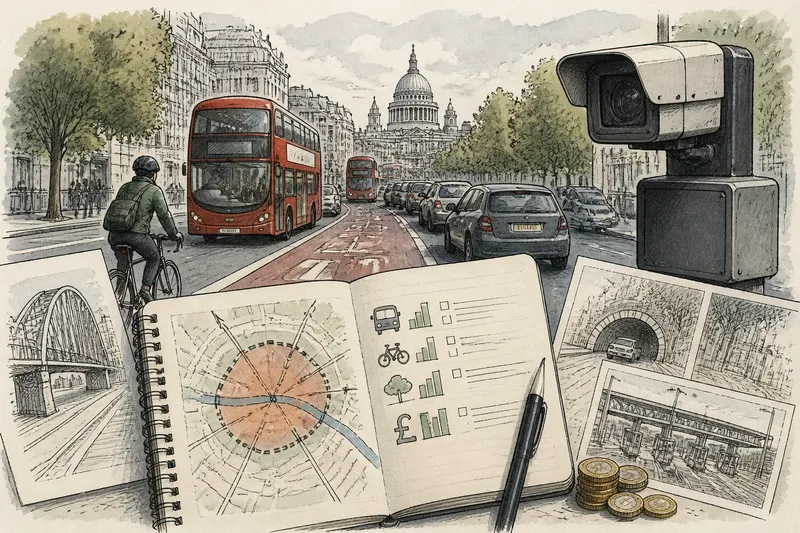
Road pricing ideas pre-date the urban congestion charge, but their history is not a neat progression from theory to settled policy. The history of road pricing ideas is better understood as a set of proposals that different governments and economists have framed around different problems.
Road pricing basics
Road pricing is a broad term for charging vehicles to use a road, bridge, tunnel, zone or part of a network. A bridge toll is one form; a charge for driving within a busy city area is another. The shared feature is that access carries a price at the point of use.
The label does not tell you the purpose. A toll may help pay for a crossing, while a city charge may aim to influence traffic, raise funds or account for costs imposed on other street users. Those objectives can overlap, but they are not interchangeable.
Scarce road space
One influential economic argument treats road space as a limited resource. When many drivers use the same route at once, each additional vehicle can slow others. A charge is proposed as a way to make some of that shared cost part of an individual travel decision.
A busy road is like a narrow doorway: more people pressing towards it do not make passage quicker. Pricing is one possible way to manage demand, but the analogy leaves out practical questions about who can pay, who needs access and what alternatives are available.
Ideas and implementation
Road pricing appeared in economic debate before authorities could readily apply charges across ordinary urban streets. The chronology varies by country and proposal, so it is safer to distinguish the general idea from the specific systems later adopted. Economists discussed charging for road use and congestion; city governments, meanwhile, had to consider how a charge might be collected and enforced.
Conventional tolls had a clear collection point at a bridge or tunnel. Extending charges to an open street network raised harder questions: where to draw a boundary, which journeys to include and how to identify vehicles without stopping them. That difference helps explain why proposals for broad urban charging could remain politically and administratively difficult, even where the economic argument was familiar.
Shifting policy aims
Congestion, transport funding, environmental effects and access have all appeared in arguments for road charges. Their prominence depends on the place and proposal; there is no single universal sequence in which one aim replaced another. A policy document should state which aim takes priority if the goals conflict.
- Managing congestion: If the stated concern is traffic pressure at particular times or in a defined area, then assess whether the scheme monitors traffic there; otherwise, ask which outcome it is designed to change.
- Raising transport funds: If revenue is a central purpose, then check which services may receive it; otherwise, the funding claim needs clearer boundaries.
- Reducing harmful effects: If noise, emissions or conflicts over street space are cited, then check whether the authority plans to monitor those effects; otherwise, the environmental case remains an untested intention.
- Improving access: If more dependable bus, bicycle or walking journeys are promised, then check which access outcomes are tracked; otherwise, a lower car count alone cannot answer the claim.
- Supporting road upkeep: If maintenance is the stated reason for charging, then check whether the proposal identifies the relevant spending purpose; otherwise, the link between payment and upkeep is unclear.
- Balancing the aims: If traffic reduction and revenue are both priorities, then check how the authority will respond if they pull in opposite directions; otherwise, the scheme has no clear way to resolve that tension.
A charge intended to raise funds may be designed differently from one intended to deter peak-time driving. A central-zone scheme can also affect people who live elsewhere but work, provide care or deliver goods within the area. These are design questions, not details that the label “congestion charge” settles.
Technology and collection
Electronic identification and camera-based systems made it more practical to collect charges without stopping each vehicle at a booth. They allowed proposals to consider charging across an area or at particular times, rather than only at a physical crossing.
Technology did not resolve the political choices. Boundaries, exemptions, enforcement and payment arrangements still determine who is charged and how a scheme works in practice. Easier collection is not the same thing as agreement about the purpose.
Congestion charging in cities
Congestion charging is a particular form of road pricing, generally associated with a defined urban area or set of travel conditions. Its rationale draws on the idea that road capacity is limited, while its public case may also involve traffic management, transport funding or access.
Say a city authority is considering a charge for a central district where buses are delayed and short car journeys share limited street space. It identifies the district as the area under consideration, proposes charging during its busiest periods and states that proceeds would support transport services. The intended observable outcomes are less pressure on the centre and more dependable bus journeys; the authority would still need to monitor those outcomes rather than assume the policy had achieved them.
Questions about road pricing?
Is road pricing the same as a congestion charge?
No. Road pricing includes tolls and other charges for road use; congestion charging is one approach focused on traffic in a defined urban area or under specified conditions.
Was road pricing invented to reduce pollution?
No single purpose defines the idea’s history. Arguments have included the efficient use of road space, congestion, transport funding and environmental effects, with the emphasis varying by proposal and place.
Why are bridge tolls simpler to collect?
A bridge or tunnel provides a clear point where vehicles pass and can be charged. A street-network scheme must also decide its boundary, which journeys qualify and how payment will be collected.
Does a charge always reduce traffic?
Not necessarily; the result depends on the scheme’s design and the travel options available to affected people. Authorities need to assess outcomes against stated aims rather than infer success from the existence of a charge.
Reading the history
The history of road pricing ideas is not just a story of collection technology. It is also a record of changing policy arguments, with different proposals attaching different purposes to the same basic instrument. When reading a current proposal, check the problem it names, the journeys it covers, the use of any proceeds and the outcomes the authority plans to publish.
That last point is useful because an aim is not an outcome. A proposal that says what it intends to change, who may be affected and how those changes will be assessed gives readers a clearer basis for judging the policy than a broad claim about traffic or fairness.